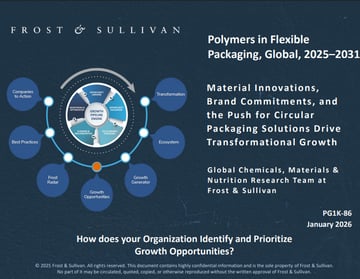
The polymers in flexible packaging industry is mature yet dynamically evolving, driven by deep-rooted consumer and regulatory trends. Polyethylene (PE) and polypropylene (PP) dominate the space, valued for their versatility and cost-effectiveness. However, this fragmented and competitive landscape is under pressure to transform. The industry's future depends on a decisive shift from complex, difficult-to-recycle multi-material laminates toward recyclable mono-material structures, bio-based alternatives, and a robust circular economy framework.
Important Industry Facts
- Polyethylene is the dominant material, accounting for 66% of the total market volume (65.58 MMT) due to its versatility and cost-effectiveness
- The industry remains heavily reliant on virgin fossil-fuel-based resins, which constitute 94-96% of the market, while post-consumer recycled (PCR) and bio-based resins together represent less than 6%.
- The Food & Beverage sector is the largest end user, driving nearly 60% of the total demand for flexible plastic packaging.
- The Asia-Pacific (APAC) region is the largest and one of the fastest-growing markets, consuming 43.08 MMT (43% of global volume) and exhibiting a revenue CAGR of 5.4%.
Download Growth Opportunities
Strategic Imperatives: Forces Reshaping Your Strategy
Disruptive Technologies
Integrate a "material-plus-data" approach by combining advanced physical materials like bio-based polymers with digital tools for lifecycle visibility, traceability, and compliance tracking.
Innovative Business Models
Accelerate the transition from single-use to circular systems by scaling reusable packaging models like refill stations and return schemes, transforming waste management challenges into revenue opportunities through technically advanced solutions.
Geopolitical Chaos
Build resilient, localized supply chains through strategic partnerships and scenario planning to mitigate geopolitical risks, ensure business continuity, and protect profitability in volatile markets.
How is your organization adapting to a mature yet rapidly evolving flexible packaging industry shaped by circular economy policies and cost-performance priorities?
Growth Opportunities Shaping the Industry
Companies can invest in and partner to develop advanced sorting and recycling technologies specifically suited for flexible formats like pouches and sachets.
Ingredient manufacturers need to develop specialized additives that enhance the mechanical properties, processability, and barrier performance of bioplastics like polylactic acid (PLA) to make them viable for high-volume packaging applications.
Resin producers must engineer high-performance PE and PP grades that can deliver the barrier and strength properties once reserved for multi-layer laminates.
Download the Full Frost & Sullivan Analysis to
- Access revenue and volume forecasts by polymer (PE, PP, polyethylene terephthalate [PET]), end-use industry, and region to target high-growth segments.
- Gain an in-depth view of growth drivers, best practices, restraints, and pricing trends to build a resilient strategy against supply chain and cost pressures.
- Get detailed insights on overcoming recycling challenges and leveraging disruptive technologies like mono-material structures and chemical recycling.
And much more!
Sign up for a complimentary Growth Pipeline Dialog™
A Growth Pipeline Dialog is a structured discussion with our growth experts providing unparalleled technology intelligence and proven implementation best practices. This discussion will spark innovative thinking and help generate a pipeline of growth opportunities you can leverage to maximize your company’s future growth potential.
Upon completing the dialog session, you will receive a $1,000 honorarium as a token of our appreciation, which can be used towards the purchase of our products or services.