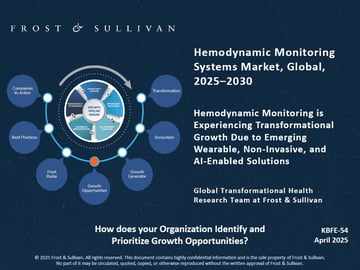
Capturing a $1.99 Billion Opportunity in Hemodynamic Monitoring Systems
From Critical Care to Connected Monitoring: The Evolution of Hemodynamic Monitoring
Hospitals are rapidly shifting from traditional invasive monitoring to minimally and non invasive, digitally enabled hemodynamic monitoring solutions. Advances in AI enabled analytics, wearable sensors, and remote monitoring help clinicians track cardiovascular health more accurately while extending use beyond critical care.
Our latest analysis shows how MedTech innovators and healthcare providers are advancing capabilities with smarter devices, integrated hospital systems, and new care delivery models. These moves help teams make faster clinical decisions, improve outcomes, and support monitoring across a broader range of care settings.
Download Growth Opportunities
Ecosystem Snapshot
- Growth Drivers: Personalized care, remote monitoring, AI integration
- Companies to Action: BD, Getinge, ICU Medical
- Key Technologies: AI driven analytics, wearable monitoring devices, remote patient monitoring platforms
Where does your organization stand in the evolving hemodynamic monitoring landscape?
Advancing Hemodynamic Monitoring Innovation: Our Latest Analysis Provides With:
Strategies to overcome growth barriers, from integrating hospital systems to managing cost pressures and adapting to evolving care models.
Emerging opportunities across minimally and non invasive monitoring, wearable technologies, and remote patient monitoring solutions.
Regional insights and investment priorities across North America, Europe, Asia Pacific, Latin America, and the Middle East & Africa.
Discover the competitive dynamics, new technologies, and industry megatrends shaping the future of hemodynamic monitoring systems.
Sign up for a complimentary Growth Pipeline Dialog™
A Growth Pipeline Dialog is a structured discussion with our growth experts providing unparalleled technology intelligence and proven implementation best practices. This discussion will spark innovative thinking and help generate a pipeline of growth opportunities you can leverage to maximize your company’s future growth potential.
Upon completing the dialog session, you will receive a $1,000 honorarium as a token of our appreciation, which can be used towards the purchase of our products or services.