Humanoid Robotics Transforming from Prototype to Workforce Infrastructure
Humanoid robotics is entering a critical transition phase, moving beyond controlled R&D settings into structured industrial and commercial deployment. Capabilities that were once limited to pilot demonstrations are now being engineered for operational environments.
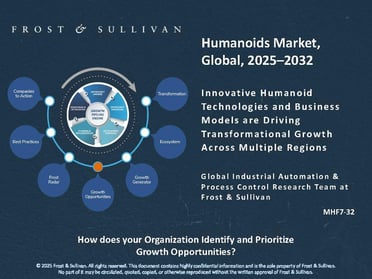
Frost & Sullivan’s recent analysis, “Humanoids Market, Global, 2025–2032,” unpacks the full humanoid robotics ecosystem and provides C-suite executives with the strategic intelligence needed to evaluate investment timing, manage risk exposure, prioritize high-impact use cases, and position their organizations for long-term competitive advantage.
- 2025 Revenue: $425.0 Million
- 2032 Expected Revenue: $4.75 Billion
- CAGR (2025–2032): 41.2%
Download Growth Opportunities
Why Humanoid Deployment Is Accelerating
- Rapid advancements in foundational AI and autonomy
- Multimodal sensor fusion enabling real-world adaptability
- Breakthroughs in actuators, batteries, and precision engineering
- Aging populations and persistent global labor shortages
Take the Next Step
Gain strategic clarity on:
- Emerging monetization models
- Regional policy and supply chain implications
- Cost trajectory projections through 2032
- Competitive benchmarking of leading OEMs
Strategic Imperatives Driving Growth in Humanoid Robotics
Innovative Business Models
Robots-as-a-Service (RaaS), leasing, and subscription models reducing adoption barriers.
Disruptive Technologies
Modular AI architectures and simulation-first development enabling scalability.
Geopolitical Chaos
Diversification strategies amid semiconductor and rare earth material concentration.
Sign up for a complimentary Growth Pipeline Dialog™
A Growth Pipeline Dialog is a structured discussion with our growth experts providing unparalleled technology intelligence and proven implementation best practices. This discussion will spark innovative thinking and help generate a pipeline of growth opportunities you can leverage to maximize your company’s future growth potential.
Upon completing the dialog session, you will receive a $1,000 honorarium as a token of our appreciation, which can be used towards the purchase of our products or services.