Navigating the Driveline Shift: Strategies for Sustainable Growth
The Asia-Pacific region is leading the global driveline industry, driven by large-scale electric vehicle (EV) production and aggressive electrification mandates. At the same time, OEMs worldwide are accelerating investments in compact electric drive (eDrive) solutions that unify motor, inverter, and gearbox into a single system. Declining battery costs and advances in power electronics are removing the last barriers to mass adoption of electrified drivelines. Strategic collaborations between Tier 1 suppliers and technology companies are compressing innovation cycles and reshaping the competitive landscape.
- Software-defined drivelines are gaining rapid traction, with predictive energy management and torque vectoring features improving vehicle safety, range optimization, and platform scalability across passenger and light commercial segments.
- 400–800V modular eAxle platforms are becoming the industry standard, improving efficiency, smaller battery packs, and simplified drivetrain designs across multiple vehicle segments.
- Circular design and lifecycle carbon dioxide (CO₂) reporting are transitioning from regulatory obligations to strategic differentiators, as regions like the European Union (EU), Japan, and India mandate end-to-end recyclability.
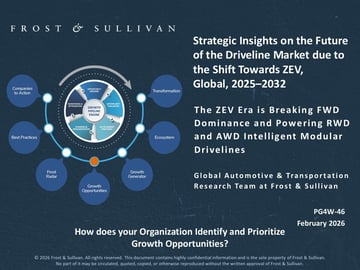
Explore Driveline Growth Opportunities
Top 3 Strategic Imperatives Transforming the Driveline Industry
Over 70% of rare earth materials processing is concentrated in China, making driveline material supply chains highly exposed to export restrictions and policy shifts. This is forcing OEMs to build multi-regional manufacturing networks.
With over $1.7 trillion in announced EV investments globally (IEA) and zero-emission vehicles (ZEVs) projected to capture 65% of passenger vehicle sales by 2032, OEMs and suppliers are accelerating drivetrain electrification strategies.
Over 60% of traditional driveline engineers have limited expertise in power electronics and thermal integration, creating critical execution gaps in electric drive programs.
Is your organization equipped to navigate these strategic imperatives and build a resilient driveline strategy?
Driveline Transformation: Key Strategies for Industry Leaders
Supply Chain Resilience
Build multi-regional manufacturing networks; invest in urban mining for 40% material circularity by 2030
Platform Modularity
Develop driveline blueprints supporting internal combustion engine (ICE), hybrid, and battery electric vehicle (BEV) variants for flexible market transitions
Digital Engineering
Deploy model-based systems engineering (MBSE) and AI-driven simulations to cut validation cycles by up to 50%
Workforce Readiness
Launch reskilling programs focused on silicon carbide (SiC) inverter design, thermal optimization, and driveline control software
Lifecycle Compliance
Implement closed-loop manufacturing with recycling partners to minimize emissions and reduce regulatory risk



How will your organization align its driveline roadmap with ZEV deadlines while sustaining competitive margins?
Fill out the form to gain instant access to the latest growth opportunities,
Sign up for a complimentary Growth Pipeline Dialog™
A Growth Pipeline Dialog is a structured discussion with our growth experts providing unparalleled technology intelligence and proven implementation best practices. This discussion will spark innovative thinking and help generate a pipeline of growth opportunities you can leverage to maximize your company’s future growth potential.
Upon completing the dialog session, you will receive a $1,000 honorarium as a token of our appreciation, which can be used towards the purchase of our products or services.