Unlocking the $52 Billion Growth Opportunity in Managed Security Services
Cybersecurity is becoming an intelligence-led discipline embedded within enterprise operations. As organizations expand across hybrid environments, cloud ecosystems, and distributed workforces, attack surfaces are growing in scale and complexity. At the same time, AI-enabled threats and evolving regulatory demands are increasing the need for real-time visibility, accountability, and faster response.
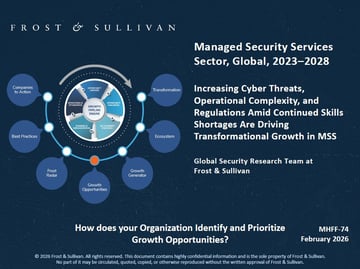
Frost & Sullivan’s analysis, “Managed Security Services Sector, Global, 2023–2028,” provides actionable intelligence on the strategies, technologies, and growth opportunities shaping Managed Security Services (MSS). It highlights how organizations can adopt platform-driven, AI-enabled models to enhance resilience, scale operations, and achieve measurable risk reduction.
MSS Industry Growth Outlook
- Current Growth (2025): $35.68 billion
- Projected Growth (2028): $52.27 billion+
- Growth Trajectory: 13.6% CAGR
Explore Growth Opportunities in MSS

Key Strategies Discussed in This Analysis
- Platformization of MSS: Transition to unified operational platforms integrating telemetry, analytics, and automation
- AI-augmented Security Operation Centers (SOCs): Adoption of human-supervised, AI-driven security operations to improve scale and efficiency
- Outcome-based Security Models: Shift toward measurable risk reduction and business-aligned security outcomes
- Secure Access Service Edge (SASE) & Security Convergence: Integration of networking and security into unified, cloud-delivered control planes
Strategic Imperatives Shaping Managed Security Services
Disruptive Technologies
AI-driven SOC automation and platform-based delivery models
Industry Convergence
Integration of security, networking, and cloud (SASE/Service Security Edge [SSE])
Customer Value Chain Compression
Shift toward outcome-driven and exposure-led security models
Who Should Leverage This Analysis
Chief Information Security Officers (CISOs)
CIOs and CTOs leading digital transformation
Security and risk leaders evaluating MSS strategies
Managed security service providers (MSSPs)
Cloud, networking, and cybersecurity solution leaders
Investors and strategy teams tracking cybersecurity market evolution
Take the Next Step
Is your organization ready to shift from reactive defense to continuous cyber resilience?
Sign up for a complimentary Growth Pipeline Dialog™
A Growth Pipeline Dialog is a structured discussion with our growth experts providing unparalleled technology intelligence and proven implementation best practices. This discussion will spark innovative thinking and help generate a pipeline of growth opportunities you can leverage to maximize your company’s future growth potential.
Upon completing the dialog session, you will receive a $1,000 honorarium as a token of our appreciation, which can be used towards the purchase of our products or services.