
Human Machine Teaming: Defense Growth Beyond Platforms
Where Will Defense Firms Compete as MUM-T Moves from Concept to Contract?
Map Defense Growth Pathways
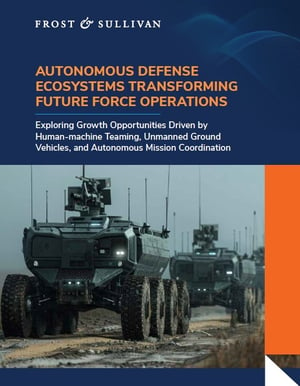
Defense programs are entering a decisive phase. Manned platforms are being redesigned to operate with unmanned aerial, ground, surface, and undersea systems, while unmanned ground vehicles (UGVs) are becoming a practical route for land forces to extend reach, reduce crew exposure, and improve mission persistence.
This combined Frost & Sullivan analysis connects the larger MUM-T shift with the ground robotics opportunity. MUM-T (Manned-unmanned Teaming) is projected to reach USD 7.64 billion by 2027, while military UGV revenue is forecast to rise to USD 2.22 billion by 2030.
For autonomy providers, robotics OEMs, mission electronics specialists, and systems integrators, the opening is not only in vehicle supply. It is in the software, sensing, payload, navigation, communications, and interoperability layers that make teaming viable.
Inside the Combined Analysis
- How MUM-T is changing capability planning across air, land, and naval operations
- Where UGVs are gaining traction across ISTAR (Intelligence, Surveillance, Target Acquisition, and Reconnaissance), combat, explosive ordnance disposal (EOD), transport and logistics, and CBRN (Chemical, Biological, Radiological, and Nuclear)
- Why open architectures and modular payloads are influencing acquisition choices
- How North America, Europe, APAC, and the Middle East are advancing programs at different speeds
- Which deployment barriers could affect adoption, including cyber exposure, operator workload, and autonomy limits

Strategic Imperatives Reshaping the Opportunity
Transformative Megatrends
Unmanned systems are becoming central to survivability, force multiplication, and hazardous mission execution.
Disruptive Technologies
Edge computing, advanced sensing, secure networks, swarming, and onboard autonomy are changing mission coordination.
Competitive Intensity
Primes, robotics specialists, and nontraditional technology firms are competing for roles before supplier ecosystems mature.
Ready to Align Your Defense Strategy with the Next Phase of Autonomous Operations?